


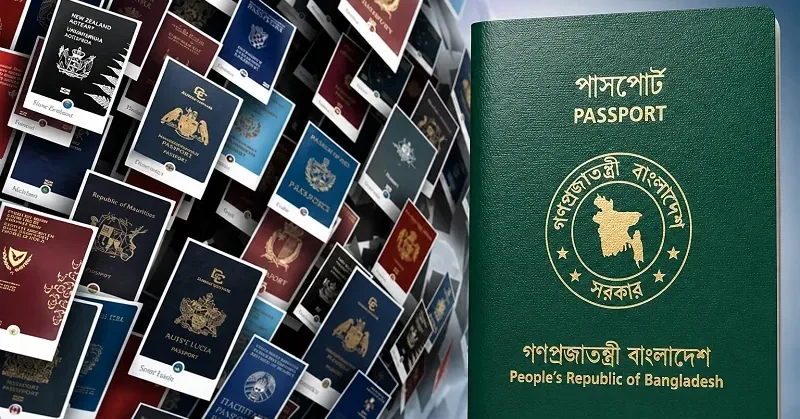
Bangladesh has ranked 192nd among 199 countries in Arton Capital's latest Passport Index, placing sixth among South Asian nations. The ranking highlights the country's limited international travel access, with Bangladeshi passport holders able to visit 17 destinations without obtaining a visa in advance.
The updated index was published on the organisation's website on Wednesday (November 25). It evaluates the strength of passports based on the international travel opportunities available to their holders. Bangladesh recorded a mobility score of 65 in the latest ranking.
According to Arton Capital, Bangladeshi passport holders can travel to 17 countries without a visa. They can also enter 66 destinations by obtaining a visa on arrival. These facilities allow travellers to avoid the process of securing a visa before departure for those destinations.
However, Bangladeshi citizens must obtain visas in advance to visit the remaining 115 destinations included in the index. This indicates that advance visa requirements continue to apply to a significant number of international destinations for Bangladeshi passport holders.
Among South Asian countries, Bangladesh ranks behind five nations: the Maldives, India, Bhutan, Sri Lanka and Nepal. Pakistan and Afghanistan are positioned below Bangladesh in the regional ranking. This places Bangladesh sixth among the eight South Asian countries included in the comparison.
The global rankings of South Asian countries also show considerable differences. India holds 128th position, followed by Bhutan at 163rd. Sri Lanka ranks 180th, while Nepal stands at 183rd. Pakistan is placed 194th, and Afghanistan occupies 198th position.
Although Bangladesh ranks ahead of Pakistan and Afghanistan, it remains behind the other five South Asian countries. India's position is particularly higher than Bangladesh's, reflecting the difference in international travel access between the two countries.
Arton Capital, a Canada-based financial advisory firm, launched its Passport Index in 2014. Since then, the organisation has published rankings assessing the international mobility offered by passports from different countries.
The index considers the number of destinations passport holders can visit without a visa, those where they can obtain a visa on arrival, and destinations accessible through electronic travel authorisation. These factors are used to assess the mobility score and determine the overall position of each country's passport.
It is worth noting that Arton Capital is not the only organisation that publishes a global passport ranking. UK-based Henley & Partners also regularly releases its own Passport Index. However, the two organisations follow different methodologies and assessment criteria.
As a result, the same country's passport may receive different rankings in the two indices. Therefore, Bangladesh's position should be understood in the context of the specific ranking system used by each organisation.






Comments
No comments yet. Be the first to write one.
Leave a comment