


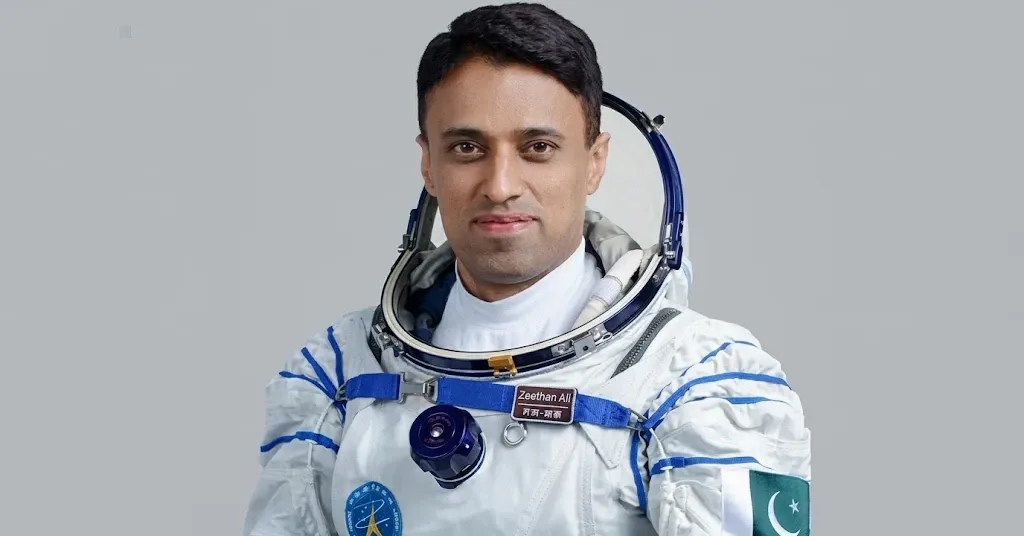
Carrying the hopes of around 250 million Pakistanis, the country’s first astronaut, Muhammad Zeeshan Ali, has entered orbit aboard China’s Shenzhou-24 spacecraft.
The 40-year-old Pakistani pilot launched on Wednesday, November 25, from the Jiuquan Satellite Launch Centre in northwestern China. The mission marks a historic milestone as Ali is set to become the first foreign astronaut to visit China’s Tiangong space station.
The spacecraft was launched at 8:18 am Beijing time aboard a Long March-2F rocket. It successfully entered its designated orbit shortly after liftoff, and Chinese space authorities declared the launch a complete success.
Ali is accompanied by two Chinese astronauts, Tang Hongbo and Wu Yi. Tang is serving as the mission commander, while Wu is the flight engineer. Ali will work as a payload specialist.
Pakistan’s Planning Minister Ahsan Iqbal, who is visiting China, witnessed the astronauts’ farewell ceremony and the launch. In a post on X, he described the mission as the beginning of a new era for Pakistan’s space programme.
He also said that the hopes and aspirations of 250 million Pakistanis had travelled into space with their national flag, highlighting the growing technological cooperation between China and Pakistan.
Zeeshan Ali to Spend 5–10 Days in Space
The Shenzhou-24 mission is heading to China’s Tiangong space station, where Ali will become the first foreign national to visit the facility.
He is expected to spend between five and ten days in space, participating in scientific experiments and other activities alongside Chinese astronauts. According to China’s Manned Space Agency, the mission includes around 90 scientific experiments and technology tests covering several research fields.
The activities will include space science experiments, routine station operations and maintenance, as well as research involving the effects of the space environment.
Ali is expected to return to Earth aboard the Shenzhou-23 spacecraft, which has been docked at the Tiangong station since May.
The mission is part of a broader space cooperation agreement between China and Pakistan signed in February 2025. Under the agreement, two Pakistani candidates, Zeeshan Ali and Khurram Daud, were selected for astronaut training in China. Ali was subsequently chosen for the spaceflight.
‘I Carry the Name of Pakistan on My Shoulder’
Speaking at a press conference at the Jiuquan launch centre on Tuesday, Ali expressed gratitude to the Chinese government for helping him fulfil his dream of travelling to space.
He said that when he joined China’s astronaut training programme several months ago, he carried the hopes and expectations of 250 million Pakistanis with him.
“I’m not flying for myself. I carry the name of Pakistan on my shoulder,” he said, expressing his commitment to representing his country.
Ali described the mission not as a final destination but as the beginning of a new journey. He also expressed hope that China-Pakistan space cooperation would expand through future joint missions, including possible exploration of the Moon and Mars.
Addressing young people in Pakistan, he encouraged children who would watch his journey to continue dreaming and pursuing their ambitions.
He also spoke emotionally about leaving his family behind for what would be the longest period he had spent away from home. Ali said he hoped to look for the lights of his home when he first viewed Earth from space.
China’s Tiangong Station and a Longer Mission
China’s Tiangong space station, whose name means “Heavenly Palace”, was completed in late 2022 and has since hosted regular astronaut crews conducting scientific research.
Unlike a routine crew rotation, the current mission includes an unusual arrangement. Shenzhou-23 commander Zhu Yangzhu is expected to remain aboard Tiangong for approximately one year to participate in research on the long-term effects of spaceflight on the human body.
If completed as planned, the extended stay could set a new record for the longest continuous spaceflight by a Chinese astronaut.
The research is expected to contribute to a better understanding of how the human body responds to prolonged exposure to the space environment.
Zeeshan Ali’s flight represents a major milestone for Pakistan’s space ambitions and a significant step in China-Pakistan scientific cooperation. It also highlights China’s efforts to expand international participation in its crewed space programme.






Comments
No comments yet. Be the first to write one.
Leave a comment